IMPLANTOLOGY

Full mouth implant rehabilitation in Nice

Specialized surgical care for the replacement of one or more missing teeth, with precise treatment planning and solutions tailored to both straightforward and complex clinical cases.

Schedule an initial consultation

Key points

The clinic collaborates closely with referring practitioners to ensure continuity of care. It manages complex cases—including bone deficiencies, grafting procedures, and implant failures—and provides structured post-operative follow-up designed to support healing and long-term implant success.

At the 47VH clinic in Nice, these situations are managed within a specialized framework in implant dentistry, periodontology, and oral surgery, with an approach tailored to bone grafting, sinus lift procedures, extensive tooth loss, or revision treatment after implant failure.

Full Mouth Dental Implant Treatment: Implant Rehabilitation for Complex Cases

Complete tooth loss or the presence of a dentition with a poor prognosis can impair chewing function, speech, and occlusal balance.

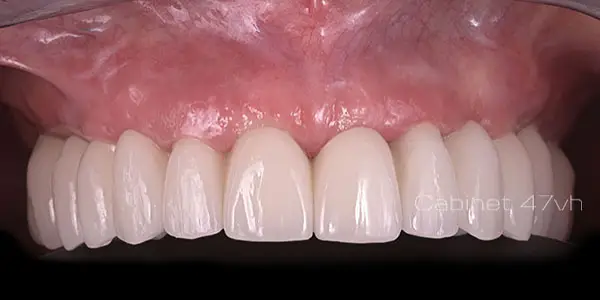
Full implant rehabilitation is now a reliable solution for replacing all teeth with a fixed implant-supported reconstruction.

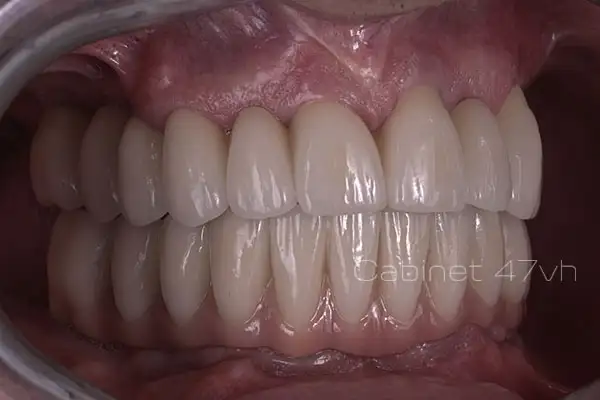
The practitioner places several dental implants in the jawbone to support a full fixed implant-supported prosthesis. This reconstruction replaces all teeth with a stable and functional restoration.

In many clinical situations, the entire implant reconstruction can be performed during a single surgical session, including the extraction of compromised teeth, implant placement, any necessary bone grafting procedures, and the delivery of an immediate provisional restoration (immediate loading).

At the 47VH implant clinic in Nice, this full implant rehabilitation can, in certain clinical situations, be performed in a single surgical session.

What is full mouth implant rehabilitation?

A dental implant is an artificial titanium root inserted into the jawbone to replace a missing tooth. When all the teeth in an arch need to be replaced, several implants can support a full implant-supported prosthesis.

This reconstruction makes it possible to restore a fixed dentition supported by implants and to reestablish functional occlusal balance.

Unlike conventional removable dentures, implant-supported restorations generally offer:

  • better stability
  • more efficient chewing
  • improved functional comfort
  • a more natural aesthetic integration

Full mouth implant rehabilitation requires careful planning to ensure the implant-prosthetic and biological stability of the treatment.

Schéma d'un cas complexe d'implantologie

In which cases should full mouth implant rehabilitation be considered?

The practitioner may consider full implant rehabilitation when all the teeth in an arch can no longer be preserved or when conventional prosthetic solutions are no longer able to restore stable chewing function.

In these situations, the dental surgeon analyzes the clinical condition, the periodontal status, the available bone volume, and the biomechanical constraints before determining whether full implant reconstruction represents the most appropriate therapeutic option.

Several clinical situations may lead to proposing this type of treatment.

Cases of complete tooth loss

Complete tooth loss refers to the absence of all teeth on a jaw. This situation can lead to a significant reduction in chewing ability as well as instability of removable dentures.

In this context, full implant rehabilitation allows stabilization of a fixed prosthesis supported by several dental implants. This approach aims to restore more effective chewing function and improve the stability of the prosthetic reconstruction.

Before considering this treatment, the practitioner analyzes the available bone volume and the condition of the tissues to determine the feasibility of implant reconstruction.

Dentition with a poor prognosis

In some situations, the remaining teeth show significant damage: extensive caries, dental fractures, bone loss related to advanced periodontitis, or multiple restorations that have become unstable.

When preserving the teeth can no longer ensure long-term function, the practitioner may consider extracting the compromised teeth followed by full implant reconstruction.

This therapeutic strategy then makes it possible to restore a stable fixed dentition supported by implants, following precise surgical and prosthetic planning.

Prosthetic failures

Some patients experience repeated failures of prosthetic treatments, particularly when several successive restorations become unstable or non-functional.

In these situations, full implant rehabilitation may represent a therapeutic alternative that allows reconstruction of the dental arch on more stable biological foundations.

The practitioner then performs a thorough clinical and radiological assessment to evaluate the possibility of placing several implants intended to support a full prosthetic reconstruction.

Implantology for complex cases

Full implant reconstruction is frequently performed in the context of complex implantology cases. Long-standing tooth loss, periodontal diseases, or progressive bone resorption can reduce the available bone volume and complicate implant placement.

Before any procedure, the practitioner performs a thorough clinical assessment combined with three-dimensional imaging (CBCT). This evaluation allows precise analysis of bone volume, the position of anatomical structures, and biomechanical constraints.

When the available bone is insufficient to ensure optimal implant stability, various surgical techniques can be used to reconstruct bone support suitable for implant placement.

At the 47VH clinic in Nice, these complex situations are managed through precise surgical planning in order to optimize implant stability.

Insufficient bone volume

After a tooth extraction, the alveolar bone gradually resorbs in the absence of functional stimulation. This resorption can reduce the height or thickness of the bone and make implant placement more complex.

The practitioner then evaluates several parameters:

  • available bone height
  • the thickness of the bone ridge
  • the proximity of anatomical structures (maxillary sinuses, inferior alveolar nerve)
  • bone quality

When bone volume is insufficient, the surgeon may consider bone reconstruction techniques in order to create a favorable environment for implant placement.

Bone grafting

Bone grafting allows the increase of bone volume in areas where the bone is insufficient. The practitioner uses bone substitute biomaterials or bone grafts to reconstruct the missing bone volume.

This bone reconstruction can be performed:

  • before implant placement
  • simultaneously with implant placement
  • during a combined surgical procedure in complex situations

The objective is to restore bone volume compatible with implant stability and the long-term durability of the prosthetic reconstruction.

Bloc osseux utilisé pour greffe osseuse avant implant dentaire

Sinus lift

In the posterior maxilla, the proximity of the maxillary sinuses may limit the bone height available for dental implant placement.

Sinus floor elevation, also known as a sinus lift, involves repositioning the sinus membrane to create space for the formation of new bone volume.

The practitioner can then place a graft material in this space to promote bone regeneration.

This technique makes it possible to restore sufficient bone height for implant placement in the posterior regions of the maxilla.

Full Mouth Implant Rehabilitation in One Day

In certain clinical situations, the practitioner can perform full implant rehabilitation during a single surgical session. This approach makes it possible to combine several therapeutic steps in order to reduce the number of procedures and quickly restore functional dentition.
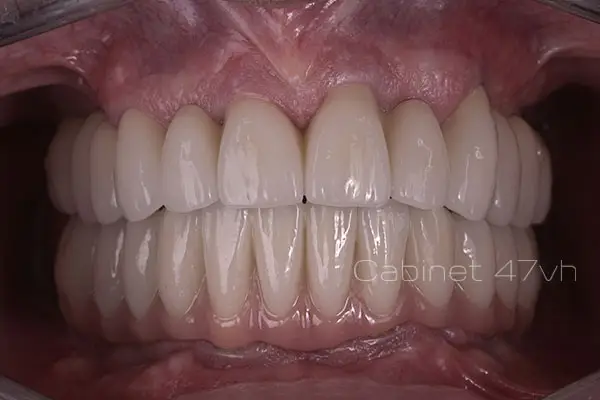
When anatomical and biological conditions allow, the treatment may include the extraction of compromised teeth, placement of dental implants, and insertion of an immediate provisional prosthesis.

This therapeutic strategy relies on careful planning and the achievement of sufficient primary implant stability. The practitioner therefore performs a precise evaluation of the clinical situation before proposing this type of treatment.

This approach is regularly used at the 47VH implant clinic in Nice when biological and mechanical conditions allow.

Extraction of compromised teeth

In situations where the remaining teeth present significant damage — extensive caries, fractures, or mobility related to advanced periodontitis — preserving them no longer ensures long-term function.

The practitioner then proceeds with the extraction of the compromised teeth. This step allows the elimination of infectious foci and prepares the surgical site for implant reconstruction.

The extraction is performed with particular attention to preserving bone volume and the surrounding tissues.

Implant placement

After the extractions, the practitioner places several dental implants into the jawbone according to the previously established treatment plan.

The three-dimensional planning performed using CBCT imaging makes it possible to determine:

  • the number of implants required
  • their ideal position
  • their orientation within the bone

This step aims to achieve sufficient primary stability to allow placement of a provisional prosthetic reconstruction.

Immediate provisional prosthesis (immediate loading)

When the implants demonstrate sufficient stability, the practitioner may place an immediate provisional prosthesis, also referred to as immediate loading.

This prosthesis allows the patient to have a provisional fixed dentition immediately after the surgical procedure.

During the healing phase, this provisional restoration maintains function and aesthetics while protecting the implants during the osseointegration period.

After the bone healing phase, the practitioner provides the final implant-supported prosthesis, designed to meet the patient’s functional and aesthetic requirements.

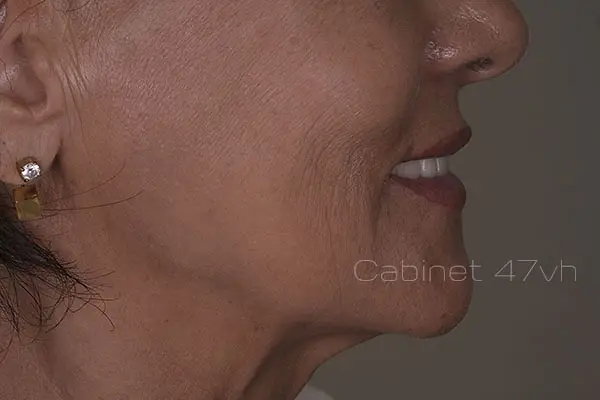
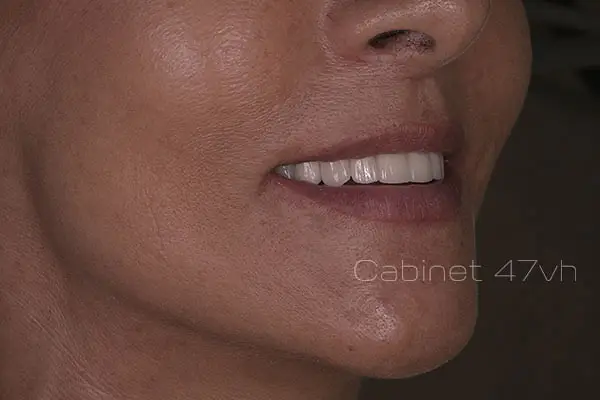
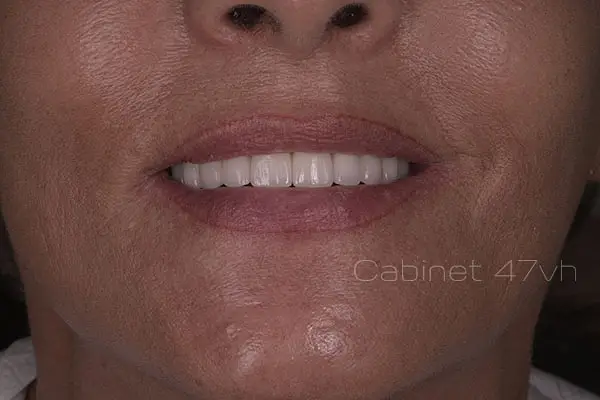
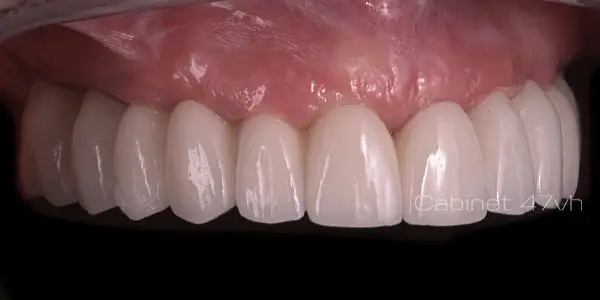
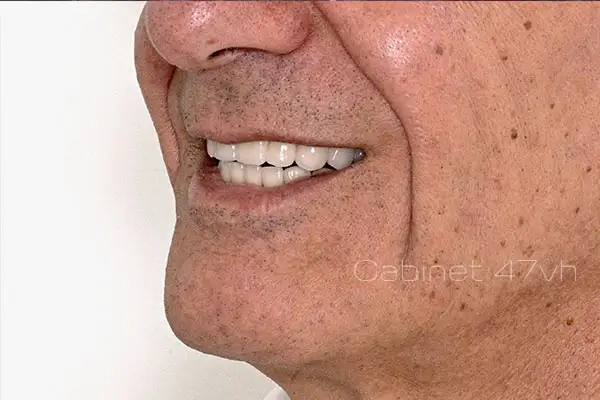
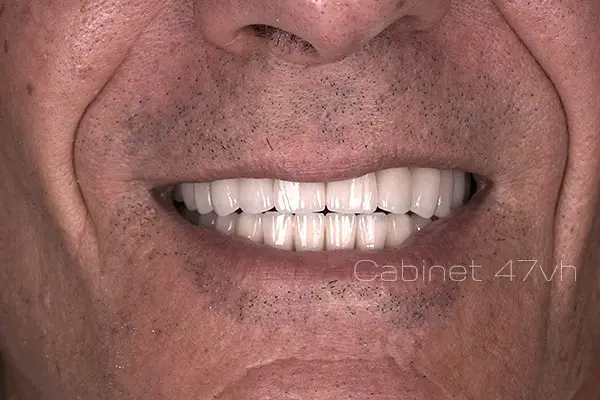
Résultat esthétique après traitement implantaire au cabinet 47VH à Nice

Full Implant Rehabilitation: All-on-4 and All-on-6 Techniques

In the context of full implant rehabilitation, the practitioner distributes several implants within the dental arch to support the fixed prosthesis.

The approaches known as All-on-4 or All-on-6 are based on the placement of four to six implants strategically positioned in the jawbone to support a full fixed prosthesis.

These implants serve as support for a full implant-supported prosthesis.

The practitioner determines the implant configuration based on:

  • the available bone volume
  • the distribution of biomechanical forces
  • the prosthetic treatment plan

Each indication is subject to individualized planning.

Vue intra-orale du résultat d’une réhabilitation implantaire complète au maxillaire

Planning of Full Implant Rehabilitation

The success of full implant reconstruction relies on precise surgical planning.

The practitioner performs a detailed clinical examination and complements this assessment with three-dimensional imaging (CBCT).

This imaging allows evaluation of:

  • the available bone volume
  • the position of anatomical structures
  • the ideal orientation of the implants

La planification tridimensionnelle permet d’optimiser la stabilité primaire des implants et de sécuriser l’intervention chirurgicale.

Chirurgie implantaire guidée par planification numérique

Duration of Full Implant Rehabilitation

The duration of full implant rehabilitation varies depending on the initial clinical situation.

In many cases, the practitioner can perform tooth extractions, implant placement, and placement of a provisional prosthesis during the same surgical day.

A healing phase known as osseointegration then allows the bone to bond durably with the surface of the titanium implants. This biological phase generally lasts several months.

After this healing period, the practitioner places the final implant-supported prosthesis.

Postoperative care

The dental surgeon performs implant surgery under local anesthesia.

After the procedure, postoperative effects are generally mild. Slight swelling or localized sensitivity may occur for a few days.

The practitioner systematically provides postoperative instructions in order to optimize healing and prevent complications.

Un suivi clinique régulier permet ensuite de contrôler l’intégration des implants et la stabilité de la reconstruction prothétique.

Clinical Cases of Full Implant Rehabilitation

Full implant rehabilitation cases require precise planning and a surgical approach tailored to each patient.
The examples below illustrate different implant-prosthetic reconstruction configurations performed at the 47VH clinic in Nice.

Clinical case

Ceramic implant bridge on implants

Clinical case

Ceramic implant bridges with or without artificial gum

Bibliographic References

  1. Maló P. et al. — “All-on-4” immediate-function concept for completely edentulous maxillae: a clinical report on the medium (3 years) and long-term (5 years) outcomes. Clin Implant Dent Relat Res, 2012. PubMed PMID 22008153
  2. Papaspyridakos P. et al. — A systematic review of biologic and technical complications with fixed implant rehabilitations for edentulous patients. Int J Oral Maxillofac Implants, 2012. PubMed PMID 22299086
  3. Gallucci G.O. et al. — Consensus statements and clinical recommendations for implant loading protocols. Int J Oral Maxillofac Implants, 2014. PubMed PMID 24660204
  4. Jensen S.S., Terheyden H. — Bone augmentation procedures in localized defects in the alveolar ridge: clinical results with different bone grafts and bone-substitute materials. Int J Oral Maxillofac Implants, 2009. PubMed PMID 19885447
  5. Yin X., Li J., Chen T., Mouraret S., Dhamdhere G., Brunski J.B., Zou S., Helms J.A. — Rescuing failed oral implants via WNT activation. J Clin Periodontol, 2016. PubMed PMID 26718012

Dr Sylvain Mouraret’s opinion

In my practice, a full implant rehabilitation must be carefully planned before any surgical procedure. The number of implants, their position, the occlusion, and the available bone volume must all be adapted to each individual patient. Immediate loading can significantly improve comfort, chewing function, and aesthetics in a short time, but it should only be proposed when biological and mechanical conditions are favourable. If the risk is too high, I prefer to first treat infection, perform grafting, or stabilise certain areas before proceeding with a fixed prosthetic reconstruction.

FAQ

Can all teeth be replaced with dental implants?

Yes, it is possible to replace all the teeth in a jaw with an implant-supported reconstruction.

The practitioner places several dental implants into the jawbone to support a full fixed prosthesis. This solution makes it possible to restore a stable and functional dentition when all the teeth need to be replaced.

Precise clinical and radiological planning makes it possible to determine the number of implants required and the feasibility of the treatment.

How many implants are needed to replace a full dental arch?

The number of implants required to replace a full dental arch generally ranges between four and six implants.

These implants are strategically positioned in the jawbone to support a full fixed prosthesis. Protocols known as All-on-4 or All-on-6 are based on this implant distribution.

The exact number of implants depends on the available bone volume, the distribution of biomechanical forces, and the prosthetic treatment plan.

Can implants be placed on the same day as extractions?

Yes, in certain clinical situations, implants can be placed on the same day as tooth extractions.

This approach involves extracting the compromised teeth and then placing the implants during the same surgical procedure. When sufficient primary implant stability is achieved, a provisional prosthesis can also be placed immediately.

However, the feasibility of this technique depends on several biological and anatomical criteria that are evaluated during the consultation.

How long does full implant rehabilitation take?

The duration of full implant rehabilitation depends on the initial clinical situation and the surgical procedures required.

In many cases, tooth extractions, implant placement, and placement of a provisional prosthesis can be performed during a single surgical session.
A healing phase known as osseointegration then allows the bone to bond durably with the implants. This biological phase generally lasts several months before the final prosthesis is placed.

Is full implant rehabilitation painful?

No, full implant rehabilitation is generally not painful.

The procedure is performed under local anesthesia, which makes it painless during surgery. After the procedure, postoperative effects are most often mild and comparable to those of multiple tooth extractions.

Slight swelling or localized sensitivity may occur for a few days. Post-operative instructions are systematically provided to promote optimal healing.

Who can benefit from full implant rehabilitation?

Full implant rehabilitation may be considered for patients with complete tooth loss or a dentition with a poor prognosis.

The practitioner evaluates several parameters before proposing this treatment, including the patient’s general health, the quality and volume of available bone, and the condition of the periodontal tissues.

A specialized consultation combined with three-dimensional imaging allows determination of the feasibility and the most appropriate implant treatment strategy.

Schedule an Appointment for Full Mouth Implant Rehabilitation in Nice

A specialized consultation assesses your clinical situation and determines the appropriate implant treatment strategy.


Response within 48 Hours


Confidential care


Clinic dedicated to Implant dentistry