IMPLANTOLOGY
The dental implants
At the 47VH clinic, implant treatments are carefully planned to restore missing teeth in a stable, functional, and long-lasting way.
Schedule an initial consultation →
At the 47VH clinic, implant treatments are carefully planned to restore missing teeth in a stable, functional, and long-lasting way.
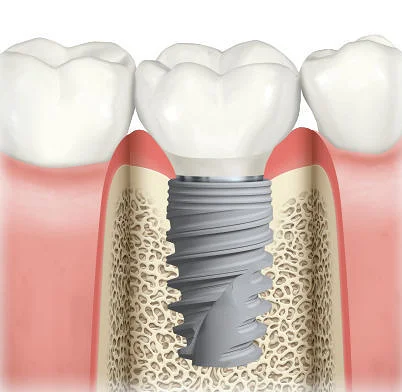
Schedule an initial consultation →A dental implant is an artificial root made of titanium or zirconia inserted into the jawbone to replace a missing tooth.
At the 47VH clinic in Nice, we plan each implant treatment using 3D imaging and exclusively use premium brand implants, recognized for their biocompatibility and durability. This approach ensures a stable, functional, and long-lasting restoration.
A dental implant is an artificial root made of titanium or zirconia that we insert into the jawbone in order to replace a missing tooth and create a solid support for the future prosthetic restoration.
After placement, bone cells gradually attach to the surface of the implant — this is osseointegration. This process takes approximately three months and ensures long-lasting stability.
We exclusively use premium brand implants made of pure titanium, recognized for its biocompatibility and long-term performance.
During the first consultation, we collect your medical history, perform a complete clinical examination, and assess your risk factors.
A three-dimensional X-ray (CBCT) enables precise analysis of the available bone volume, the position of anatomical structures, and planning of the procedure.
When the bone volume is insufficient, a bone graft may be recommended. These procedures are now well mastered and show a high success rate.

We perform the surgery in a fully equipped operating room for your comfort and safety. Local anesthesia is administered after application of a pre-anesthetic gel. Conscious sedation is available upon request.
Placing an implant takes approximately 15 minutes. You will feel no pain during the procedure.
In the posterior area, we place a healing cap on the implant flush with the gum. In the anterior aesthetic area, an immediate-loading temporary prosthesis is generally placed during the same appointment. Sutures are resorbable or removed after 15 days.

Three months after placement, we verify that the bone has fully integrated with the implant.
We then take an impression so that your referring dentist can design the final prosthesis — crown, bridge, or implant-supported denture — fixed on an abutment screwed onto the implant.
Regular maintenance sessions are necessary to preserve the health of peri-implant tissues and prevent peri-implantitis. We recommend them every six months.
In the vast majority of cases, post-operative discomfort is less bothersome than after a tooth extraction.
A simple paracetamol-based pain reliever is enough to manage discomfort during the 3 to 4 days following the procedure. No time off work is generally required.
The surgical placement fee for a titanium implant is €1,100. The prosthetic crown made by your referring dentist represents a similar cost.
If there is insufficient bone or gum tissue, a complementary graft may be needed — its cost will be specified in the quote. We systematically provide a detailed, personalized quote before any treatment, with the option of interest-free installment payments.
The quality of implants and the training of practitioners vary considerably from one clinic to another. At the 47VH clinic, we exclusively use high-end implants, placed by practitioners holding a post-graduate degree in implantology.
A properly placed and well-maintained dental implant can last a lifetime.
The prosthetic crown placed on the implant may require replacement after 15 to 20 years, depending on wear. The implant success rate exceeds 90% at 15 years. Regular maintenance follow-up is key to long-term longevity.
Absolute contraindications are rare — the vast majority of patients are eligible.
Certain situations require a prior evaluation: uncontrolled diabetes, heavy smoking, bisphosphonate therapy, cervicofacial radiotherapy, or insufficient bone volume. In the latter case, prior bone grafting can often make implant placement possible.
Smoking is the main risk factor for implant failure — we strongly recommend stopping before and after the procedure.
It reduces bone vascularization, impairs osseointegration, and increases the risk of peri-implantitis. Smoking cessation significantly improves long-term prognosis.
Smoking is the main risk factor for implant failure — we strongly recommend cessation before and after the procedure.
The bridge requires grinding down the adjacent healthy teeth to serve as abutments. The implant preserves these teeth intact, maintains bone volume, and generally offers a better long-term prognosis.
Yes, in carefully selected situations — this is known as immediate implant placement.
This approach helps reduce the number of surgical procedures and preserve post-extraction bone volume. However, it requires strict conditions: absence of active infection, intact bone walls, and sufficient primary stability.
In standard cases, the final prosthesis is placed three months after implant placement.
This delay corresponds to the osseointegration phase. When immediate loading is possible, a temporary prosthesis is placed at the end of the procedure, allowing the patient to avoid being without teeth during healing.
Surgical placement of a dental implant is not reimbursed by the National Health Insurance system.
However, the implant-supported crown has been partially covered since 2021 under the “100% Health” scheme, depending on the teeth involved. Your complementary health insurance may also contribute depending on your contract coverage. A detailed treatment estimate is provided during the consultation.